


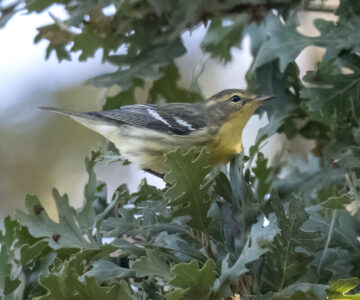
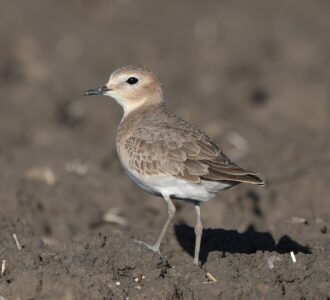
Mountain Plover ©Josh Greenfield
Fall came to a close and with its end came the cold, dreary days of winter. Our winter birds have arrived en masse, and with them a nice sprinkling of rare birds have shown up as well.
An out-of-season GRASSHOPPER SPARROW on 11/5 at Capay Open Space Park was interesting as a potential wintering individual, but it does fall within the window of prior late-fall records (FF). A RED CROSSBILL flying over north Davis on 11/25 was exciting, and may be part of a broader irruption of the species region-wide (LWD, KD). A YELLOW-BELLIED SAPSUCKER was photographed at the Cache Creek Preserve on 11/6 (CCC). An additional YELLOW-BELLIED SAPSUCKER was found on 11/22 on County Road 42 in Guinda, about a quarter-mile off Highway 16 (EI, ES, ZP). There are just over a dozen YELLOW-BELLIED SAPSUCKER records for the county. Another unusual sapsucker has been seen repeatedly at Willowbank Ditch in south Davis, beginning 11/6 (CD). It is a returning bird and seems to show traits of both YELLOW-BELLIED and RED-NAPED SAPSUCKER, indicating that this bird is likely a hybrid. Sapsuckers are infamous for hybridizing where their ranges overlap, and this bird appears to be another example.
Speaking of difficult identifications, two likely WINTER WRENS were discovered in Putah Creek Canyon this month. Distinguishing WINTER WRENS from their formerly conspecific relative, the PACIFIC WREN, is extremely difficult and requires excellent documentation. Anyone who observes these wrens should make a concerted effort to photograph and voice record these birds, and submit the documentation to eBird and the California Bird Records Committee (CBRC). The first WINTER WREN was at Putah Creek Fishing Access #3 on 11/26 (SS), and continued the following day. If accepted by the CBRC, this would be Yolo County’s third record. Another WINTER WREN, apparently returning from last winter, was found at Putah Creek Fishing Access #2 on 11/30 (JG). These individuals add to a shocking run of WINTER WRENS in Putah Creek Canyon in the past two years, with two additional records coming from across the creek in Solano County.
A handful of wintering insectivores have turned up already. With rising winter temperatures the trend of neotropical migrants choosing to spend the winter in the Central Valley is increasing. A YELLOW WARBLER was reported on 11/1 in residential Woodland (RW). At that date it is difficult to know for sure whether this was an extraordinarily late migrant on its way south, or whether it has decided to set-up-shop for the season. Three CASSIN’S VIREOS have already turned up in Davis. One individual at the UC Davis Arboretum on 11/20 has continued to be seen almost daily (MP), and birds at Slide Hill Park on 11/4 (MP), and in south Davis on 11/2 (SA), may still be in the area.
A GREATER ROADRUNNER was photographed off County Road 8 in the Dunnigan Hills on 11/25 (JG). Along Highway 45 near the Colusa County border, a group of MOUNTAIN PLOVERS has returned to the same fields as the previous five years. They were first reported this winter on 11/18 (KS), and the flock has since grown to dozens of individuals. A group of MARBLED GODWITS continues to be seen in different ponds near the Yolo County Landfill, and likely are the same group continuing from previous months. There are few November records for the county. Finally, the adult WESTERN GULL has returned to Davis Wetlands, first reported on 11/20 (JT). What is very likely the same individual WESTERN GULL has returned to this location every winter for thirteen years in a row! It has not been reported since, but is probably hanging around the vicinity as it has in years past.
Thanks to the following for their reports:
Cache Creek Conservancy (CCC), Chris Dong (CD), Elliot Schoenig (ES), Emmett Iverson (EI), Frank Fabbro (FF), Jim Thomas (JT), Josh Greenfield (JG), Kirk Swenson (KS), Konshau Duman (KD), Lynette Williams Duman (LWD), Michael Perrone (MP), Rick Williams (RW), Samuel Schmidt (SS), Steve Abbott (SA), Zane Pickus (ZP)
Photos and Audio Recordings:
Winter Wren (Fishing Access #3): https://ebird.org/checklist/S155285812
Winter Wren (Fishing Access #2): https://ebird.org/checklist/S155502475
Yellow-bellied Sapsucker (Cache Creek Preserve): https://ebird.org/checklist/S153959398
Yellow-bellied Sapsucker (Guinda): https://ebird.org/checklist/S155178892
Cassin’s Vireo (UC Davis Arboretum): https://ebird.org/checklist/S155339776
Cassin’s Vireo (south Davis): https://ebird.org/checklist/S153595177
Greater Roadrunner: https://ebird.org/checklist/S155199113
Mountain Plovers: https://ebird.org/checklist/S154824891
Western Gull: https://ebird.org/checklist/S154867367
–Zane Pickus