Conservation Corner

Conservation Corner: September 2026

New Habitat Conservation Projects on Our Part of the Sacramento River The Sacramento River has a long history of severe constriction inside flood-control levees.  Today’s river managers understand that giving the river more room to meander down the valley both reduces the risk of unwanted flooding and makes space for

Read More

Conservation Corner: May 2026

The YBA Small Grant Program Yolo Bird Alliance offers funding for work on the lives of birds in Yolo County and nearby areas.  The main aim is to help new investigators, mostly UCD students, get started on projects of interest to YBA.  The Small Grant Program has been busy supporting

Read More

Conservation Corner: April 2026

Lake Alhambra Lake Alhambra, in the northeast corner of the residential part of Davis, is the largest body of water within several miles.  It is also the only place for water-oriented birds that I can readily reach by bicycle.  So I check it fairly often in the cooler months. It

Read More

Conservation Corner: March 2026

Scrub-jays and Valley Oaks These two icons of Central Valley nature have close ties.  The California scrub-jay is one of the most common birds in Yolo County, while the valley oak was once the most numerous tree away from watercourses.  This oak occurs only in California, and the scrub-jay occurs

Read More

Conservation Corner: February 2026

Fifty-five years of Christmas Bird Counts along Putah Creek The Putah Creek Christmas Count is by far the longest-running bird survey in our area, and holds a trove of information about the shifting status of birds as both land use and climate relentlessly change.  Now YBA Christmas Count chair Bart

Read More

Conservation Corner: January 2026

The American Kestrel NestBox Project Continues Last April, this column reported on an effort to support populations of the American Kestrel by installation of nest boxes in auspicious spots in Yolo County. The project began in 2023 with ten boxes on select City of Davis properties. It has since grown

Read More

Conservation Corner: December 2025

Birding Takes a Place in Popular Culture    In recent months, birding has rapidly grown in prominence in American popular culture. It seemingly began with the release of Listers, a feature-length documentary about competitive birding. The film follows Quentin and Owen Reiser, two brothers who become birders by spending a

Read More

Conservation Corner: November 2025

A Breeding Bird Atlas for Yolo County – and for California      At a recent meeting, the Yolo Bird Alliance Board of Directors voted to join an ongoing statewide effort to produce a breeding bird atlas for each county. The atlas will document the population status, geographic distribution and

Read More

Conservation Corner: October 2025

A New Habitat Project in the  South Yolo Bypass        The southernmost edge of our county, along dirt roads into the Yolo Bypass, is a place birders seldom visit. A mix of marsh, rice fields, and winter-flooded grassland and shrubland, it is nearly all private property. The California

Read More

Conservation Corner: September 2025

Short-distance Migration Fall migration, the most exciting season for birding in these parts, is in full swing.  Birds from far away visit Yolo County for a short time, on their way from summer to winter quarters.  And there are three other kinds of migration, accomplished by species normally considered non-migratory.

Read More

Conservation Corner: May 2025

Climate Warming is Killing Nestling Birds Earlier this year National Audubon along with a coalition of conservation organizations released a study (the 2025 U.S. State of the Birds report) that found recent large declines in bird numbers across the country and across many species.  The continued conversion of habitat, both

Read More

Conservation Corner: April 2025

Kestrels in Our County   Yolo County’s smallest and most familiar falcon, the American kestrel, has been declining in numbers across its wide North American range in recent years.  There is some evidence that it is losing ground locally as well.  In natural situations, kestrels nest in tree cavities in

Read More

New Habitat Conservation Projects on Our Part of the Sacramento River
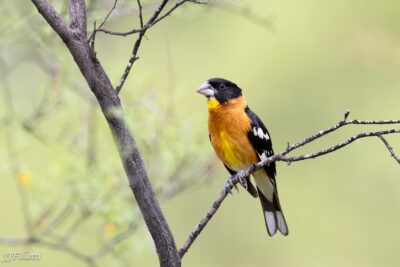
Black-headed Grosbeak ©JoAnne Fillatti

The Sacramento River has a long history of severe constriction inside flood-control levees.  Today’s river managers understand that giving the river more room to meander down the valley both reduces the risk of unwanted flooding and makes space for vegetation that is important bird habitat.
   Looking at a map of the river in northern Yolo County, from the Colusa County line downstream to the head of the Yolo Bypass at Fremont Weir, one sees a series of sharp bends in the river and U-shaped lakes alongside it, reminders of a time when the river chose its own route.  Now a nonprofit organization called River Partners, based in Chico, has won State grants to restore floodplain habitat at two sites in this stretch.  I toured both sites this past summer with the project director, Mike Davis.
   One site, called Dos Rios Norte, is on the river at its confluence with the Feather River.  It preserves a chunk of magnificent old forest.  Beginning in 2028, workers will install hundreds of thousands of native plants, everything from grasses to trees.  Gradually the place should look something like the forest on the Cosumnes River Preserve does today.  About 175 acres of unforested land has been planted to native herbaceous vegetation, which will flood in most winters.  Then it will offer habitat for juvenile salmon – and for the birds that eat them.  The property has significant water rights, which are being dedicated away from crop irrigation and toward increasing stream flows.
   The other project, the Turning Point Preserve, is across the river from Tyndall Landing in north Yolo County.  It’s near the rice dryer you can see from State Highway 45.  The site is a thousand acres, two hundred of them planted to organic rice inside the levee.  The rest is in row crops outside the levee, and will likely be restored to forest.  River Partners hopes to move the levee back, so as to subject more of the property to flooding and its ecological benefits.
   Once again this year, both project areas will take part in the “BirdReturns” program (see Conservation Corner, December 2023), in which fields in key locations are flooded to provide crucial shorebird habitat in spring and again in late summer and fall.  And, unlike most habitat development in our area, both projects intend to be open to the public when construction ends.  Mike Davis has offered early access to Yolo Bird Alliance for field trips and other visits.  If you are interested, or for information about other work at River Partners, contact Mike here. 

–Michael Perrone, Conservation Chair