
Lake Alhambra
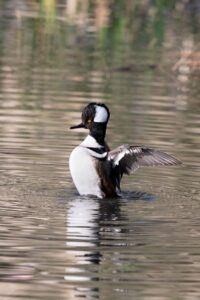
Hooded Merganser ©Ann Brice
Lake Alhambra, in the northeast corner of the residential part of Davis, is the largest body of water within several miles. It is also the only place for water-oriented birds that I can readily reach by bicycle. So I check it fairly often in the cooler months.
It turns out to support a few mollusc-eaters (goldeneye and bufflehead) and numerous fish-eaters. At various times it hosts hooded and common mergansers by the dozen, pied-billed grebes, cormorants, up to five species of herons, and a kingfisher. Last fall it had two kingfishers for a few days. They chased each other obsessively, calling loudly while flying in wide circles that took them a half mile or more from the lake itself, until only one remained.
The fish-eaters are apparently attracted to the mosquitofish planted by the Sacramento-Yolo Mosquito and Vector Control District, which each year raises and releases vast numbers of mosquitofish for use as predators of mosquito larvae. Mosquitofish are prolific breeders in the warmer months. In winter the armadas of mergansers join forces to herd the mosquitofish up against the shore of Lake Alhambra and proceed to pick off the trapped fish. Meanwhile herons quickly move to the spot, standing at the waterline to catch fish that try to escape the mergansers. A pincers movement, you could call it.
This winter the birds were so effective at fishing that the thirty hoodies and twenty-five common mergansers present on 22 December shrank to just two hoodies and ten commons by 4 January and no fish-eaters of any kind by 15 January. It has remained that way since then.
In the two prior winters the story was similar, with merganser numbers peaking in December and January, then dwindling quickly. This year the change was so striking that I called the mosquito control district to tell them that Lake Alhambra was possibly fished out, while conditions remained excellent for mosquito breeding. The district sent out a surveyor in mid-March, who confirmed the presence of sufficient numbers of mosquitofish. The surviving fish normally wouldn’t breed until April or so—though this year’s bizarre hot weather has accelerated their schedule. All’s well that ends well, thanks in part to the mosquito district.
–Michael Perrone, Conservation Chair