
Wild Turkeys in the City
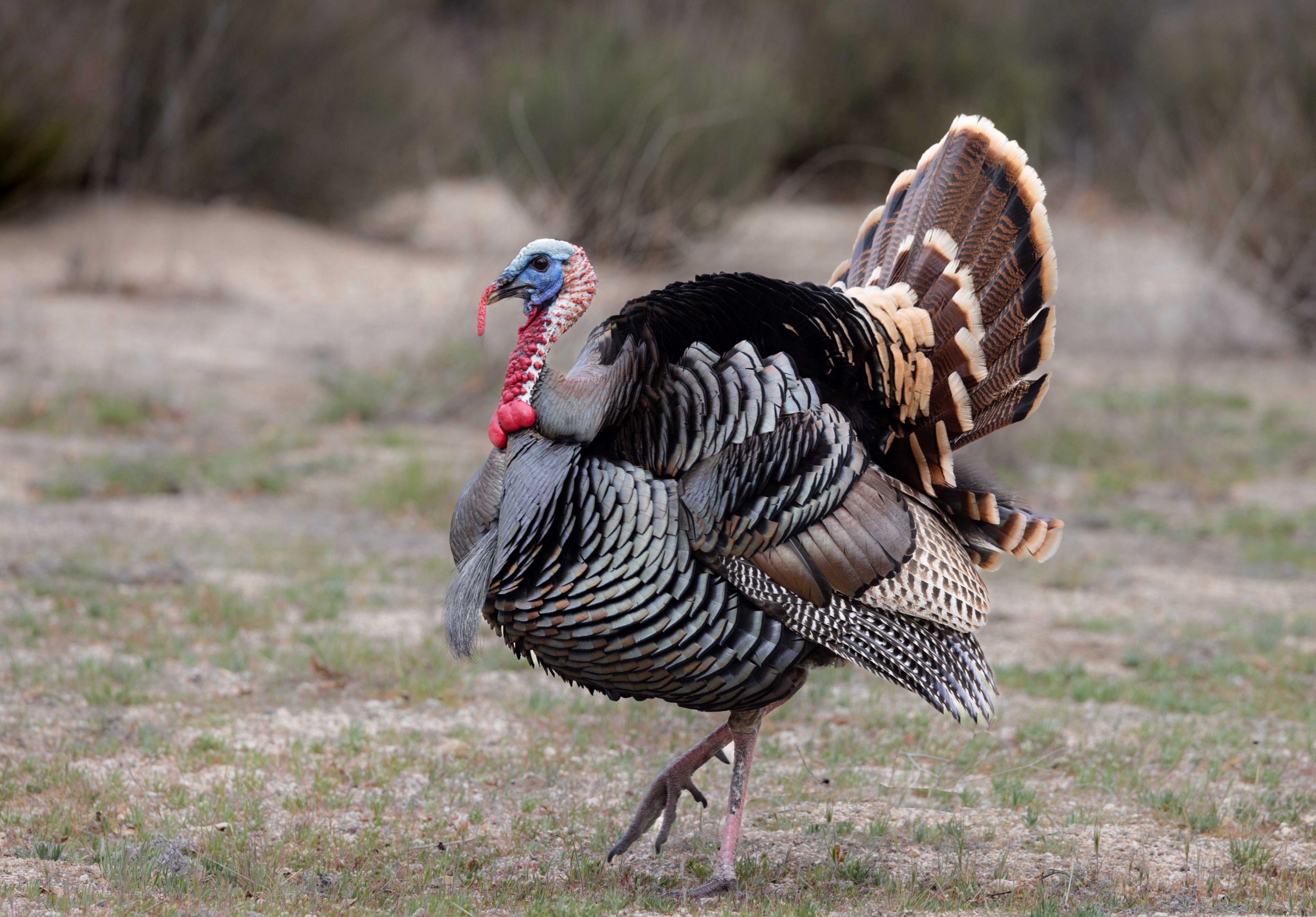
A male Wild Turkey performing a courtship display ©Ann Brice
Now that Thanksgiving is behind us, let’s talk turkeys. The wild turkey is native to the eastern US, northern Mexico, and parts of the American southwest. It probably got its odd name because it reminded early settlers of the guinea-fowl, another large chicken-like bird with a featherless head, domesticated in Europe and with folklore attributing its origin to somewhere further east (though guinea-fowl are actually from Africa).
The State fish and wildlife department has for many years released turkeys widely for hunting, with the earliest Yolo County records apparently in Capay Valley in 1960. Turkeys became more widespread by about 1990, and there are now records from around the county. The species is most noticeable – and much tamer – in our cities, where it can be both a charm and a nuisance.
Both sexes start to breed at age three. Males compete to attract hens, and successful ones form so-called harems. Hens typically lay ten to twelve eggs. Losses are heavy when chicks are small, but by the time birds are half-grown, they are likely to survive their first summer. A season’s offspring form a flock with their mother, and such flocks may band together to form larger flocks of up to about twenty birds in fall and winter. Adult males loosely associate with them.
Davis seems to be home to both the most turkeys and the most complaints about them, so much so that the city biologist, John McNerney, works to track their numbers and the location of flocks. McNerney counts birds as they go to their night roosts, normally in trees and sometimes on rooftops. This year he has located four roosts with about eighty birds. He notes that twenty years ago the cemetery hosted only nine birds. One evening last month I counted forty.
A reading of eBird records suggests that there are six or seven flocks in Davis. This includes flocks near North Davis pond, West Davis pond, the University arboretum, Davis cemetery and arboretum, Oak Grove Park in northeast Davis, Mace Ranch Park, and Putah Creek Park in south Davis. What the areas all seem to have that turkeys need is a patch of brush, tall grass or weeds away from development, which offers undisturbed nest sites for this ground-nesting bird. However, McNerney has found nests in residential landscaping. Perhaps the wilder areas are valued more as safe spots to rest between foraging bouts.
Unlike Davis, turkeys in Woodland seem restricted to the east edge of town, where town merges with open fields. Because the birds happily feed in residential neighborhoods, it may be that the manicured nature of parks and open spaces in Woodland largely precludes nesting opportunities there. Likewise, few turkeys are reported from West Sacramento, almost all in less urban areas east of Jefferson Boulevard.
It is unclear whether the total number of city birds is changing. I have a hard time counting them accurately. Birds can move between flocks, and groups of birds can leave a flock and return to it in the course of a day. Because of the gradual maturation process, younger age classes are tough to distinguish. This makes it harder to verify the number of birds by age and sex in a flock, which would help identify individual flocks. Adult males are distinctive looking, but can go their separate way. Some flocks slowly disappear or shift their home range.
Turkeys are omnivores. Considering their large size and big broods, they are capable of eating considerable numbers of small reptiles and amphibians, and plant seedlings and seeds, such as acorns. This may not matter in cities, but in wilder places they could do much damage to native fauna and flora. City policy in Davis discourages people from feeding them. I agree completely. We do not need more turkeys.
If you have information about a flock, roost or nest in Davis, John McNerney would like to hear from you.
— Michael Perrone, Conservation Chair