
Fifty-five years of Christmas Bird Counts along Putah Creek
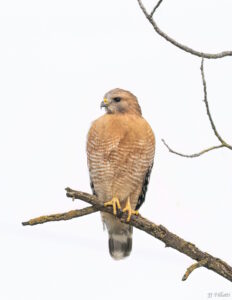
Red-shouldered Hawk ©JoAnne Fillatti
The Putah Creek Christmas Count is by far the longest-running bird survey in our area, and holds a trove of information about the shifting status of birds as both land use and climate relentlessly change. Now YBA Christmas Count chair Bart Wickel has done us a huge favor by making those data easily accessible as bar charts that plot the number of individuals of each species across each of the fifty-five count days.
The data downloader is at hydrospheric0.github.io/cbc-historic/. Simply click on the species name and its respective bar chart appears. You can see instantly the big increases, big declines, and steady numbers over the years. Some changes were expected and some are surprises. Let’s have a look.
First are species new to the region since the counts began. Wild turkey showed up in 1993, having been introduced here as a game bird, and its numbers grew for about twenty years. Eurasian collared-dove was new in 2005, having immigrated from further south as part of a continent-wide expansion, and levelled off after about ten years. Common raven was very scarce till about 2003, then grew steadily in numbers and perhaps has reached a new baseline level. As noted in an earlier column (April 2024), ravens gradually returned from the remote wilderness after people stopped shooting them.
Next are species that adapted to urban life and grew as our cities grew. Canada goose numbers began an upward swing in about 1993, as it acquired the habit of nesting in city parks and golf courses. Red-shouldered hawk increases reflect their recent willingness to nest in cities and forage there. The bird was a rarity in the first ten years of the count. Black phoebe shows the same trend, probably for the same reason – now widespread in towns all year, no longer restricted to waterways. Western bluebird is up steadily in the last two decades, doubtless helped by the provision of nest boxes.
There are some declines associated with habitat loss. The conversion of grasslands and fields to cities, orchards and vineyards helped push big reductions in ring-necked pheasant, especially since 2005; white-tailed kite since 1995; yellow-billed magpie and loggerhead shrike since about 2004; and rough-legged hawk since 1997, though other factors are also at work against the hawk, continent-wide.
Changes in conditions on Putah Creek affected waterfowl there. Since about 1995, common goldeneye, and about ten years later, bufflehead, have exploded in numbers. These birds eat mainly clams and snails, and I suspect that the gradual silting-in of Lake Solano has been good for the molluscs and thus for the birds. A big drop in American wigeon numbers since about 1990 may also be linked to changes in Lake Solano, which is where most of them were early on. Puzzling to me is the explosion in hooded merganser numbers since about 1988, both on Putah Creek and on isolated ponds.
The milder, largely fog-free winters of recent years seem to have boosted species that prefer warm places. Growth in turkey vulture numbers is linked to the loss of fog that opened up the Sacramento Valley to their foraging. Warmer winters, often coupled with the expansion of residential areas and their flower gardens, likely has helped Anna’s hummingbird, house wren, phainopepla, northern mockingbird and western tanager to show big gains in the last two decades. But a swift and a wren defy the trend. White-throated swift, an aerial insectivore presumed to benefit from mild winters, has declined sharply in the count circle (though not everywhere nearby) since about 2000. On earlier counts it occurred mainly in Putah Canyon. And Pacific wren colonized that very canyon beginning in 2013, despite a warming climate that should have repulsed such a cold-hardy northern species. Maybe Putah Canyon is the coldest place in the count circle.
–Michael Perrone, Conservation Chair