
Northern Birds in the South
This column follows up on the situation I reported last time. In the twenty-first century, a dozen or so southern California bird species have expanded their winter ranges to include the Sacramento Valley. They appear to have taken advantage of the milder winter weather and the food, mainly insects, that comes with it. Could those changes affect the cold-hardy species whose main winter ranges on the West Coast are mostly north of here and reach the Central Valley as their southern limit? Have warmer winters made our landscape less attractive to them, so that more of them stay farther north or in the mountains?
Some species that may be affected are rough-legged hawk and a group of forest and woodland birds, including red-breasted nuthatch, brown creeper, golden-crowned kinglet, varied thrush, evening grosbeak, red crossbill and pine siskin. My impression is that they have all been scarce or absent the past few years, and this hints at the possibility of a longer-term downward trend.
To explore this impression, I examined results from the Putah Creek Christmas Bird Counts from 1971 onward and records from my neighborhood in Davis since 1986, and then consulted the eBird database to see the bigger regional picture. As it turned out, the small number of evening grosbeak and red crossbill records on the Christmas Count prevented reliable conclusions about them. But there were two notable findings.
First, on the Christmas Count these species have indeed been harder to find in the last seven to ten years than in prior decades. Similarly, in my neighborhood red-breasted nuthatch, golden-crowned kinglet and evening grosbeak have gone undetected in the past two or three winters, and red crossbill has turned up only twice in the last nine years.
However, all these species showed considerable ups and downs from year to year, making a solid trend harder to discern. Furthermore, their recent low numbers have come ten or so years after the arrival of the southern California species, rather than at the same time. This makes it less likely that the two groups of birds have responded to the same changing climate in the Valley.
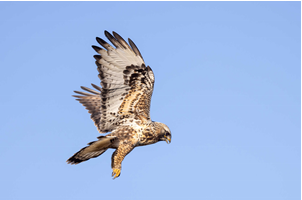
The second finding is that a long-term change in abundance was clear in only one species, rough-legged hawk. Sixty of them were seen in the first two decades of the Putah Creek Christmas Count, but only six in the last two decades. County-wide, it has nearly vanished in that time.
According to eBird, this fits a broader pattern. In the last fifteen years the species has declined by about half across its winter range in the West, which is mainly in the Great Basin, and by almost as much in the Sacramento Valley. Losses in our area are doubtless compounded by extensive conversion of grassland and farm fields to orchards, vineyards and subdivisions. This same habitat loss seems at least partly responsible for the recent decline of northern harrier, both on the Putah Creek Christmas Count and throughout the Sacramento Valley.
In sum, the role of changes in winter climate on the abundance of any of these birds is still obscure in our area. The good news for winter birding is that we have lost only one northern species, rough-legged hawk, in this century and gained about a dozen southern ones.
Rough-legged Hawk
photo by Ann Brice
— Michael Perrone, Conservation Chair