
Hearing aids for birders – a personal story
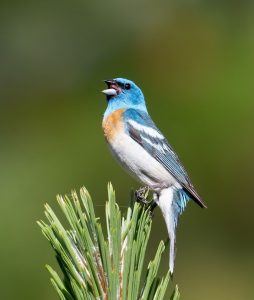
Lazuli Bunting ©Ann Brice
Many birders rely crucially on our ears to detect and identify birds. But what happens when our ears start to wear out? As we age, our capacity to hear higher-pitched sounds diminishes. The result is that many bird calls must be closer to us than before, in order to be heard. The change can be so gradual as to escape notice for a long time. Mine is a good example.
A few years ago, I was birding with two younger friends when they detected distant golden-crowned kinglets by voice – and I didn’t. Then, one recent winter I noticed that bushtit flocks had gotten quieter. They appeared to be talking to one another less. This seemed like an extraordinary shift in behavior. Later it struck me as much more likely that I simply could not hear them at middle distances, even though I could see them. The final indignity was in the summer of last year, when I went birding with a couple of twenty-five year olds. We finished up by discussing the birds we had encountered. They reported many more gnatcatchers, bushtits and lazuli buntings than I did, all based on detecting their high-pitched calls. They had heard distant birds that were simply beyond my range.
This was unbearable. I sought help. First, I took a hearing test, which produced an audiogram. This is a plot of pitch or frequency, measured in Hertz, against how loud, measured in decibels, a specific tone must be for you to hear it, compared to a person with normal, unimpaired hearing. My test showed a slight loss in the range of the human voice, far from enough to need hearing aids. However, the voices of nearly all small birds span a broad range of frequencies, including tones far higher than the human voice, often up to 12000 Hertz. I had mild to moderate loss in both ears at frequencies in the small bird range, above 4000 Hertz. My hearing test, like most, only went to the top of the human speech range at 8000 Hertz. So if you get tested, ask to include the highest pitch available, and good luck.
Armed with knowledge of my specific hearing loss, I talked to several birders about hearing aids, and I am grateful to all of you. As you warned me, audiologists are not accustomed to the needs of birders. I had to explain to mine that what I wanted was to hear the chirps of birds better, that is, to boost my hearing only at those higher frequencies. I understand that some health insurers may balk at that, deeming it not medically necessary. I also had to insist that I did not want the aids connected electronically to my cell phone, Bluetooth, television, or anything else.
As it turned out, there is a choice of brands of hearing aids with models that can be programmed to specific frequencies. Those models are costly – about as much as a guided birding trip to Latin America – but they were worth it to me. My ears are not back to being twenty-five years old, but I have recovered a lot. Direct measurement showed that the aids let me hear bushtits, and presumably many other species, at two or three times the distance I can without hearing aids. But note the limits of the technology. If you can’t hear a particular tone at any volume, a hearing aid will not bring it back.
There is a learning curve in adjusting to the new sound environment. Along with the lower pitches I could hear before, I now hear the softer and higher-pitched harmonics that are often part of bird calls. They can add in strongly enough to change the quality of some calls. For example, without hearing aids, I can readily separate the chip notes of black-throated grey and Townsend’s warbler, but with aids, black-throated grey sounds a bit sharper and higher, more like Townsend’s. I also hear all manner of unfamiliar lisps, squeaks and peeps that could be mildly annoying to some users.
But let’s face it. If we are lucky, we will continue to go birding as we grow older, and hearing aids will only become more attractive.
— Michael Perrone, Conservation Chair