
Scrub-jays and Valley Oaks
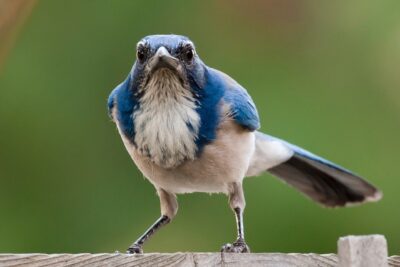
California Scrub-jay ©Lynda Goff
These two icons of Central Valley nature have close ties. The California scrub-jay is one of the most common birds in Yolo County, while the valley oak was once the most numerous tree away from watercourses. This oak occurs only in California, and the scrub-jay occurs throughout the range of the oak. Valley oaks grow best on flat ground with deep soil and a high water table, that is, with underground water close to the land surface. These same features make such land ideal for irrigated farming and for housing, and it is now rare to find extensive groves of this species anywhere.
What brings scrub-jays and oaks together is acorns. Acorns come in many sizes and shapes, depending on the species. Those of valley oak are unusual, being the largest among California oaks, as well as long, slim, and roughly conical, nearly flat where the stem attaches and pointed at the other end – a shape ideal for being pounded into the ground. When a big oak in my neighborhood has mature acorns, the normally territorial scrub-jays come from all directions to harvest them. They carry the acorns home and cache them for later dining. Their big, strong beaks hammer the flat end, driving the pointy end into the earth.
Valley oaks do not thrive in the shade of a parent tree, and they depend almost entirely on scrub-jays, both for dispersal (including transport uphill) and for planting of acorns, with the root end helpfully oriented downward. Acorns ripen in autumn, right before the onset of the rainy season. They germinate in winter, when soil is moist from rain, and send a taproot in search of permanent water. This is essential in our climate, with its long, hot, entirely dry summer. Taproots may go fifty or sixty feet down. Thirty to forty feet is common in mature trees.
I learned that piece of valley oak biology the hard way. Once, when I was new to the area, I wanted to transplant a four-inch-high seedling to a better location. Figuring that it had a roughly four-inch root, I started to dig it up. And dig. And dig, an ever deeper and wider excavation, with no sign of the root tapering to its end. If you want a valley oak in your landscape, do what the -scrub-jays do – plant an acorn.
Where valley oaks are numerous, a single scrub-jay may harvest and plant several thousand acorns in one season. It will return to eat about half of them. Amazingly, scrub-jays remember where they store most of those thousands of acorns. Dozens of times I have seen them alight at a particular spot in the landscape, probe with the bill a bit, and come up with an acorn. Memory seems aided by placement of some acorns at visible intersections, such as where soil meets a woody plant, fence, pavement, or building. I know this because a few oak seedlings magically appear in spring in such inconvenient places, where the annoyed human resident has to dig them out.
One winter a few years ago, one member of the scrub-jay pair on our part of the block went missing, presumably having died. The next spring our yard experienced a plague of oak seedlings – from all the acorns the bird had stored and not retrieved. Not all of them were valley oaks. My neighborhood has a couple of ornamental live oaks, and from time to time I find live oak seedlings in our yard.
This article is just an introduction. For more about scrub-jays and oaks, see chapter 2 of “The private lives of public birds” by Jack Gedney. To grasp the importance of oaks to our local birds, see another book by Gedney, “The birds in the oaks.” To learn about oaks in nature, I like a 1991 book, “Oaks of California” by Bruce Pavlik and others. Finally, many anecdotes about valley oaks appear in a recent book about the Blue Ridge area called “Exploring the Berryessa Region—a Geology, Nature, and History Tour”, by Eldridge and Judith Moores and other local authors.
–Michael Perrone, Conservation Chair