
Where do our spring migrants come from?
Many of us marvel at the twice-a-year treks of migratory birds between breeding and wintering grounds. We wonder where they came from to get here, and where they go when they depart. Recent improvements in our ability to mark and track birds have provided some answers. Modern electronics provides tags small enough to attach to almost any size of bird. The tags emit radio signals that are picked up by a network of receivers, called Motus, laid out across the landscape of North and South America. The receiver stations are configured so that any station can detect and report any tag that belongs to the program. The stations are mostly in the eastern states, but are also fairly numerous in parts of California and the Seattle-to-Vancouver, British Columbia, region, and so can provide useful information in our area. Local stations are at the Yolo Bypass Wildlife Area, Conaway Ranch, Grizzly Island in Suisun Marsh, and the Cosumnes River Preserve.
Each detection of each species and receiver location is available for perusal on a digital platform called the Bird Migration Explorer. The platform, maintained by National Audubon, has all manner of information about migration. What grabbed my attention is that a user can choose a location, such as the Yolo-Sacramento area, and query the platform for records of tagged birds, species by species. The database shows locations where individual birds from our area were re-encountered. That is, it shows exactly where else some of our local birds have been.
There are several cautions when using the Explorer. First, coverage is spotty in most of the western United States. It is better west of the Sierras and Cascades, a corridor that many of our birds use. However, that means that there are many more records of our birds around Puget Sound than, say, in the Sierra Nevada.
Second, coverage is much better for waterfowl and birds of prey than for songbirds and other small birds. Third, there seem to be some errors in the data. Sabine’s gulls detected on the west coast of Mexico are listed more than once as re-encountered in our area, even though the species normally stays offshore over the ocean.
Lastly, the platform doesn’t include dates of detection. Each pair of records, one in Yolo and one elsewhere, suggests a migration path that could have been followed in either spring or fall. To simplify interpretation, I classified birds detected south of here as spring migrants that reached Yolo, and birds detected north of here as fall migrants that reached Yolo.
Bearing all this in mind, what does Migration Explorer tell us about the travel routes of Yolo County birds? Since it is now spring, this column covers birds that I classified as northbound. Starting with waterfowl, many species, e.g. cinnamon teal, pintail and snow goose, come here or pass through here from as far away as northern Mexico. Redheads were re-encountered in Texas and southern Mexico. American coots were detected at the Salton Sea. Some turkey vultures come here from the west coast of Mexico. Our mourning doves have been recorded in southern Mexico, Texas, Alabama, Maryland and Colorado.
The few songbird records from Yolo include two very long-distance migrants, olive-sided flycatcher, recorded in Costa Rica and Colombia, and Swainson’s thrush, from northwestern Mexico, offshore of Cuba, Costa Rica and Colombia. Yellow-headed blackbird has been detected in western Mexico. Species that winter closer to home include records of yellow warbler from near Los Angeles and Bullock’s oriole from near San Diego. Individual white-crowned sparrows detected here were also found through much of lowland California, as far south as San Diego.
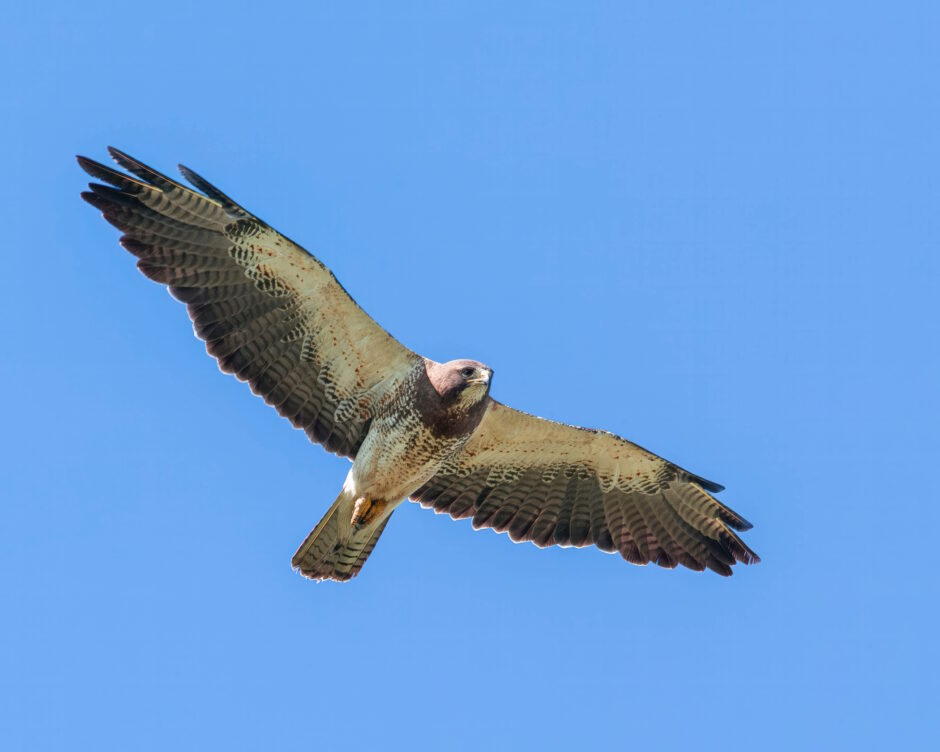
The most intriguing records are for Swainson’s hawk. Our local birds have been detected in migration in many places west of the Rockies, including near Portland, Oregon, and on their normal wintering grounds on the Pacific slope of southern Mexico. Amazingly, some have turned up in migration on the Great Plains, Arkansas, Kentucky, the east coast of Mexico, Costa Rica, and Colombia, evidently on their way to or from wintering grounds in Paraguay and Argentina, where some of our birds have also been found. South America is not the typical winter home of California birds, but of more eastern populations. Thus, Yolo birds apparently segregate before or during migration and winter in two areas about five thousand miles apart. This suggests that two separate groups of Swainson’s hawk may breed here.
A later column will report on birds I classify as fall migrants coming from the north.
The platform for the migration data reported here is at explorer.audubon.org. The website motus.org explains many aspects of the radio telemetry-based wildlife tracking system mentioned in this article.
— Michael Perrone, Conservation Chair