
The New Sacramento Area Checklist – Part 2
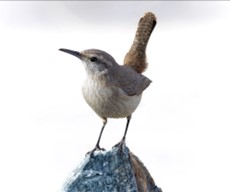
Rock Wren ©Erna Tarara
Last month I noted that the Sacramento Audubon Society has just revised its checklist of the birds of our area and made it available on its website. I set about to compare the relative abundance of each species on the current checklist with previous editions, going back to 1963. In that column I covered the many species that have become easier to find over the years in the checklist area. This column deals with those that have become harder to find.
Nearly all of the large declines have been among breeding birds. Several species that were thought to nest in the forested or shrubby parts of floodplains along the rivers have declined or disappeared. Willow flycatcher, warbling vireo, Swainson’s thrush and chipping sparrow have vanished. Yellow warbler dropped out even before 1963. Northern flicker, bank swallow and purple martin numbers are much diminished.
What happened? The construction of big dams upstream and of levees on the banks of all the major rivers provided the intended flood control that prevented the widespread flooding of floodplains that had allowed broad bands of forest and scrub to thrive. The thin lines of trees that remain next to rivers and streams have been unsuitable for successful nesting for many species. Perhaps the nests are more easily found by predators (including scrub-jays) and nest parasites (cowbirds), which themselves have become much more common. The strait-jacketing of rivers made eroding banks scarce, and thereby made bank swallow nest sites scarce. Today in Yolo County, most people see bank swallow colonies only at the gravel mines on Cache Creek.
Purple martins seem to have been displaced from nest holes in tall trees by the larger European starling. I saw martins nesting along the Sacramento River in Yolo County in the 1960’s. Now the only nests are in drain holes on the undersides of highway overpasses in an ever-declining number of locations in Sacramento. Note that starlings spread here from further east in the 1950’s, but were not common breeding birds until about 1970.
Many species nesting in wide-open grasslands have declined, in tandem with the loss of grassland to agriculture and urbanization. These include northern harrier, ring-necked pheasant, prairie falcon, burrowing owl, loggerhead shrike and lark sparrow. The owl and the falcon have declined enough in Yolo County as to become doubtful as breeding birds here. Nowadays only wintering birds of these species, down from the north, are reliably found.
Much the same is true for rock wren. It was an uncommon breeder through the 1980’s on the Sierra Nevada side of the valley, and is rare now. It was rare then in the Yolo County hills, and in the new century is almost gone as a nesting species in our county. Perhaps the repeated wildfires have harmed the remaining hillside habitat.
All of the declining grassland breeders live in our region year-round, and are more numerous in winter. Declines in winter-only species in this habitat have been few. Only the vesper sparrow stands out, again likely a victim of the loss of grassland.
Finally, the iconic bird of the Central Valley, yellow-billed magpie, has become hard to find in most of the Sacramento region. Much of its preferred foraging ground in rangeland and pasture has morphed into vineyards on our side of the valley and suburbs on the Sacramento side.
— Michael Perrone, Conservation Chair