
The Point Reyes Effect in Yolo County?
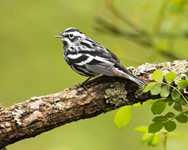
Black and White Warbler ©Lynda Goff
The Point Reyes peninsula is famous during migration periods for its concentrations of small birds, often including strays from much further east. Its shape and position, a ten-mile-long westward projection into the Pacific Ocean, draws birds that have flown out over the ocean at night and are keen to get back to the safety and feeding opportunities of dry land. On clear mornings, birds in flight over a wide span of ocean can see the peninsula and head for its patches of trees and shrubs.
Here in Yolo County, plantations of trees in an “ocean” of farmland are magnets for migrating forest birds that find themselves travelling over wide-open spaces at dawn. When my family settled in the neighborhood near Slide Hill Park, our home was in the very northeast corner of Davis. From the air, it was at the end of a lightly forested peninsula, with open farmland to the east and north. It drew birds from both of those directions, over a wide area of sky. Flocks of birds could be seen entering town from over the farm fields – band-tailed pigeon, Lewis’s woodpecker, cedar waxwing, evening grosbeak, red crossbill.
Other birds arrived one at a time, thus escaping notice in flight, but showing up in the neighborhood trees and shrubs. Among the surprises were acorn woodpecker, gray flycatcher, Clark’s nutcracker, chestnut-backed chickadee, hooded warbler, black-and-white warbler, and Cassin’s finch. It could feel a bit like Point Reyes.
Since then, the city and its trees have expanded far to the north and east, and my neighborhood is no longer the first offer of refuge for forest birds. One needs to look elsewhere for a true wooded island in a sea of farmland.
One such spot has made the local bird news lately. Near Clarksburg, the Uslan family has developed its property to attract as wide a variety of birds as possible, by establishing patches of trees and shrubs, as well as native grassland, wetlands, ponds and seasonal mudflats, plus feeders and nest boxes of several sizes. The site routinely hosts Allen’s hummingbird, and recent finds in migration include poorwill, ruddy ground dove, calliope hummingbird, gray flycatcher, magnolia warbler and black-throated sparrow, among an amazing 174 species of “yard” birds.
Doubtless there are other habitat islands in Yolo County just waiting to be discovered by birders. In the meantime, the Uslan property is a must-see. Contact Tom here for viewing opportunities.
— Michael Perrone, Conservation Chair