
From the Co-Presidents
Bird-Window Collisions
In this last newsletter of the year before our summer break, we’d like to highlight a significant risk to birds that has recently been getting more attention. Bird-window collisions, particularly in urban areas, are now recognized as one of the leading human-created causes of bird deaths. Recent research studies published in 2024 by PLOS ONE and The Wilson Journal of Ornithology found that more than 1 billion birds are killed per year in the U.S. alone from window collisions. While bird window collisions occur throughout the year, the greatest risk is during peak migration periods in the fall and spring. Birds can crash into windows and buildings during both the day and night. During the daytime, the main problem is the transparency and reflection of glass which birds cannot see. At night, when many birds migrate, artificial lighting around buildings can be fatal to birds by causing disorientation, confusion, or distraction from migratory paths, as well as collisions.
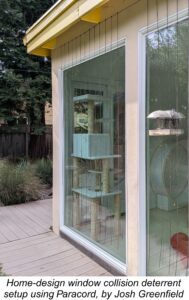
Home-design window collision deterrent setup using Paracord, by Josh Greenfield
National Audubon Society (NAS), the Cornell Lab of Ornithology, and other bird conservation organizations have been working to address these risks through public education. Programs such as NAS’s “bird-friendly-communities” project which encourages retrofitting of glass windows to make them more visible to birds, and their “Lights-Out-for-Birds” project which encourages building owners, managers and residents to turn off or dim non-essential lights at night, particularly during peak migration periods in fall and spring.
A dramatic example of an effective mitigation method to reduce bird deaths from window collisions was implemented in Chicago at the McCormick Place Convention Center building which sits on the shore of Lake Michigan directly in the flyway of migratory birds. A coating of white dot markers placed every 2 inches on the exterior surface of the building’s windows reduced the number of bird fatalities from over 1,000 a year to 40 in a single season. The window coating product is produced by a Canadian company called FeatherFriendly.
YBA will be adding a new page on the website with more resources on this topic soon. In the meantime, click here for resources about avoiding bird-window collisions.
Efforts are also being undertaken to begin monitoring and collecting data on bird deaths from window strikes in Davis. Information on what to do if you find a dead (or injured) bird, including from an apparent window strike, can be found here on our website.
Next week we’ll be sending you the slate of potential YBA board members for the 2026-2027 season, and we’ll vote on them at the Members’ Meeting on May 19th on Zoom and in person. We have a great board, and you’ll be voting to reconfirm 16 of the current members.
Finally, thanks to all the board members and friends of YBA who helped us with the planting at the Pacific Flyway Pond on April 19th and with tabling at CA Duck Days on April 25th. Both events were successful and fun.
As always, YBA takes the summer off. We look forward to seeing you in September or, hopefully, out birding sooner!
–Genevieve Colborn and Ann Brice