
Recently I decided to use eBird, Cornell University’s public database of bird observations, to store the accumulated records from birding in my neighborhood around Slide Hill Park in Davis. This meant reviewing all thirty-six years of written notes, and the effort produced two big surprises. One was that many species have experienced a large change of status in that period. The other was how few of those changes I had remembered. I only saw them as I looked through my notebooks. Finding the same set of birds every week over the past few years made me forget that it had not always been that way.
There were many changes. One was the arrival of colonists from other parts of town. In the early years, my neighborhood was at the edge of the city, and the greenery was young and somewhat sparse. As the vegetation developed, species that prefer more extensive or mature vegetation arrived, including Cooper’s hawk as a breeder, red-shouldered hawk, Nuttall’s woodpecker, bushtit, and spotted towhee in winter.
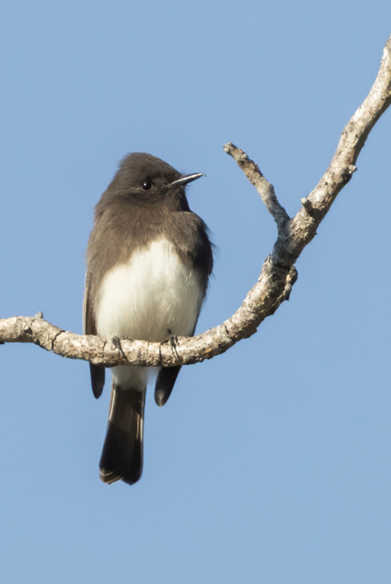
There were other reasons for new arrivals. Enterprising black phoebes left their natural haunt, probably along a year-round watercourse, to spend the winter in the park. Perhaps the presence of swimming pools made them feel at home. The species eventually stayed all year, nesting under the eaves of buildings. Permanent residence may have been feasible because the park is as well-watered as a stream, offering plenty of insect life for food, plus vertical surfaces for nesting and mud for nest-making. Today the species is all over town.
Western bluebird first appeared as a winter visitor. It took to using nest boxes as soon as they were offered, and is now widespread in the area year round. My guess is that the local bluebirds were offspring of the hugely successful UC Davis nest box program along Putah Creek. Another newbie is white-breasted nuthatch. It appeared only in the last few years, perhaps as a refugee from repeated wildfires in our western hills. At first only a winter visitor, it nested in the neighborhood in 2022.
Another big change was that some species dropped out, mainly birds of more open country that evidently disliked the encroaching urban forest. These included barn swallow and western kingbird as breeders, gray flycatcher as a rare but reliable spring migrant, chipping sparrow in spring and fall, and rock pigeon, yellow-billed magpie and house sparrow as all-year residents. The pigeon and sparrow now live in newer developments nearby, perhaps finding better nesting opportunities on the different roofing style of the homes. The disappearance of the magpie roughly coincided with the epidemic of West Nile disease that killed many of them, though it is not clear why they did not return when the disease subsided.
Other changes in the neighborhood bird list can be seen as part of more widespread regional trends in the incidence of various over-wintering birds in the Sacramento Valley. Those are next up in this column.
Black Phoebe
photo by JoAnne Fillatti
–Michael Perrone, Conservation Chair