
Recent Reports
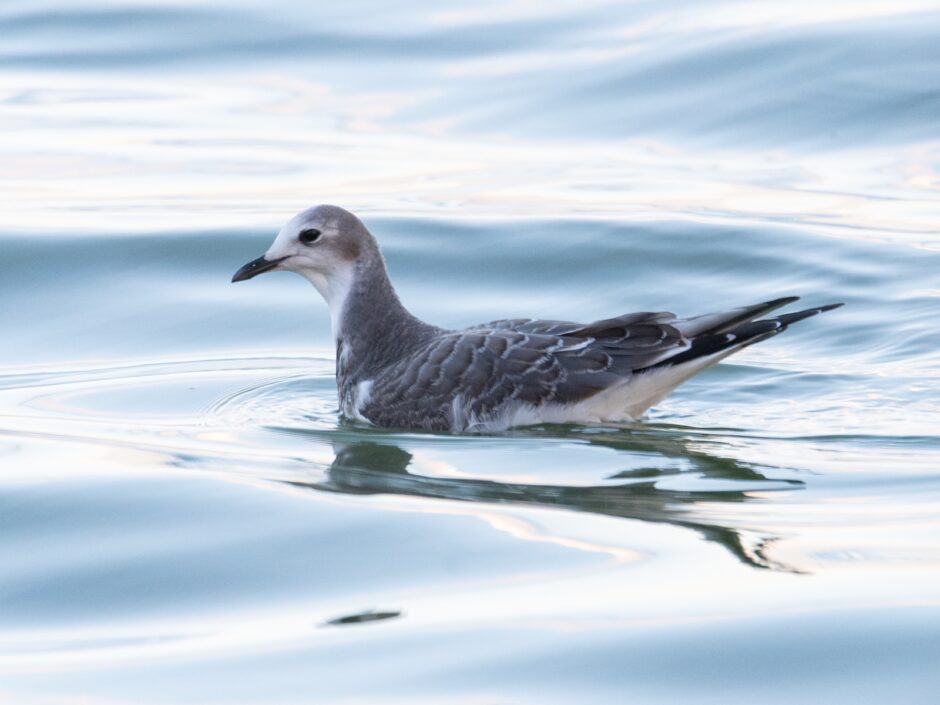
Photo of Sabine’s Gull by Julian Johnson
Every year, many birders look forward to September, the peak of fall migration when rare birds may be found anywhere, anytime. This exciting month of rarity-seeking is typically highlighted by the discovery of “vagrant” or lost songbirds mixed in with the expected western migrants. This year, however, September pulled through in a completely unexpected way! Currently, the Pacific Northwest and Great Basin regions of western North America are facing a poor cone crop and associated low food sources for montane birds. Many conifer species go through “boom or bust” cycles in their cone crops, and the intensity of this cycle may be intensified by the ongoing drought throughout much of the Great Basin. What this means for birds is that species dependent on cone seeds were forced to undergo a mass-exodus from the Great Basin earlier this fall. This event, when a high percentage of one or more species leave the core of its native range, is known as an irruption. Well, this year is one of the largest montane irruptions in decades, and here in Yolo County we are certainly observing its effects.
It started in August, when RED-BREASTED NUTHATCHES began to appear in the lowlands of California in above average numbers. Their presence increased into early September, with dozens of reports from throughout Yolo County. While this was occurring, other montane species were showing up in places they are not normally found. BAND-TAILED PIGEONS were recorded in multiple locations on the valley floor (KO, MP, JG), and HUTTON’S VIREOS popped up all over the county. Meanwhile, the excitement for potential montane rarities grew as species like CLARK’S NUTCRACKER, EVENING GROSBEAK, CASSIN’S FINCH, RED CROSSBILL, and even PINYON JAY were recorded by the hundreds out of range in southern California. It was an unprecedented event, but it still seemed far away. Which species, if any, would reach Yolo County?!
Birders began to search along ridgetops in Yolo’s western foothills, which many bird species use to migrate in fall and that provide lookout points for scanning for wandering birds. The first EVENING GROSBEAK in Yolo County this year was an adult male flying over Reiff Road at the Yolo-Lake county line on 9/20 (BW, JJ, KS, MP, SSm, ZP). CASSIN’S FINCHES were recorded migrating along ridgetops along Fiske Road above Rayhouse Road on 9/23 (KS, TU, ZP) and on 9/27 (DK, MNC, RF). A pair of RED CROSSBILLS flying over Putah Creek Canyon on 9/29 might be a sign of another species to watch out for as the irruption continues (TE).
But the most spectacular moment of the irruption so far in Yolo County took place on 9/26 at the top of Reiff Road, when an unprecedented flock of 28 CLARK’S NUTCRACKERS were seen flying by! The flock was photographed and then quickly disappeared, but not before they were counted as the fifth Yolo County record (BW, JG, JJ, KS, SSc, SSm, ZP)! They had made it! But it was just the beginning. The next day, dozens of CLARK’S NUTCRACKERS were seen flying over ridges north of Putah Creek Canyon. It started with at least six flocks totaling over 52 birds flying past Audubon Bobcat Ranch (JJ, KS, ZP). News of nutcrackers put local birders in motion, and another flock of over 44 individuals were seen that afternoon from Fishing Access #1 in Putah Creek Canyon (AE, BW, DK, JS, MNC, RF). Likely some of the same individuals were reported from Fishing Access #1 in the days that followed. It was nuts! It was crackers! The irruption was on.
Now the irruption is in full swing, and in the closing days of September, the action reached the valley floor. EVENING GROSBEAKS are turning up everywhere, with at least eight different reports totalling nearly 20 birds coming from around the county in the final days of the month. Birders have recorded them flying over Davis backyards (KD, LWD, RF), over parks in Davis (MP), flying around in the foothills (DK, JG, JJ, KS, MNC, RF, SSm, SSc, TE, ZP), and passing over Putah Creek (MP, UCD). Of all the species involved in this irruption, it is likely EVENING GROSBEAKS will continue to move around the county for the coming weeks, or even months! Most reports have involved flyovers early in the morning, but it is worth keeping an eye out in patches of fruiting trees or at backyard seed feeders.
All of the montane excitement motivated Yolo birders to look for migrating birds along ridgetops in Yolo County. This increased coverage led to some notable finds. In addition to EVENING GROSBEAKS and CASSIN’S FINCHES, three migrating TOWNSEND’S SOLITAIRES were observed along Fiske Road on 9/27 (DK, MNC, RF). Additionally, a flurry of BLACK SWIFT reports were exciting records of a species that historically has been challenging to find in Yolo. One flew over Rayhouse Road on 9/21 (JG), another meandered past Fiske Road on 9/23 (KS, TU, ZP), and birds flew by Audubon Bobcat Ranch (JJ, KS, ZP) and Valley Vista Regional Park (HH) on 9/27. More exceptional was a BLACK SWIFT in the sky over Davis on 9/3 (RF). Prior to this year, there were only around 10 county records of BLACK SWIFT for Yolo County. The montane irruption may have incidentally taught birders how to find this species more regularly in Yolo.
Amidst all of the irruption chaos, birders still recorded various rare songbirds in September. An immature male ROSE-BREASTED GROSBEAK spent a few days in Davis 9/3 – 9/5, enjoyed by many local birders as it moved about a neighborhood (RF). An adult female NORTHERN PARULA was photographed along Elk Slough on 9/8, continuing the trend of adult Parulas showing up in the Sacramento Valley this fall (KS, TU, ZP). A striking adult CHESTNUT-SIDED WARBLER at Putah Creek Riparian Reserve proved elusive during its two day stay 9/26 – 9/27, but it was well photographed (PK). A hatch-year TENNESSEE WARBLER at Putah Creek in Winters on 9/24 rounded out the list of eastern vagrants recorded in the county this September (ZP). It was seen briefly and photographed but could not be relocated. Locally rare were two GREEN-TAILED TOWHEES: one at the Putah Creek Riparian Reserve on 9/11 (KS) and one at Audubon Bobcat Ranch on 9/17 (JG, JZ, KO).
As for waterbirds, an early-returning EURASIAN WIGEON was found at Woodland Wastewater Treatment Plant (WWTP) on 9/8, and remained there throughout the month (ZP). A pair of COMMON TERNS were together at WWTP on the morning of 9/14, but disappeared shortly thereafter (ZP). Another COMMON TERN, this one in nearly full breeding plumage, stopped by briefly at WWTP on 9/17 (ZP). An immature FRANKLIN’S GULL, the second in the county this year following an adult in April, was enjoyed by many beginning 9/16 and last recorded on 9/23 (MH, ZP). Only two days later, it was replaced by a juvenile SABINE’S GULL (JJ, ZP). This beautifully patterned gull, which normally migrates over the Pacific Ocean, decided that WWTP was good enough habitat to hangout for a while and remained through the end of the month. It was enjoyed by many local birders. Those enjoying the SABINE’S GULL photographed a late WILLET at WWTP on 9/27, one of the latest fall records for the species (DS). At the Yolo County Central Landfill pond, a juvenile BAIRD’S SANDPIPER on 9/28 was also on the late end for the species (JJ). The month concluded with a flurry of reports of returning geese, including flocks of CACKLING GEESE and GREATER WHITE-FRONTED GEESE. Winter is coming next!
Thanks to the following for their reports:
Konshau Duman, Todd Easterla, Andrew Engilis, Jr., Rob Furrow, Joshua Greenfield, Marcel Holyoak, Harrison Horn, Julian Johnson, Danny Karp, Paul Knoepfler, Monte Neate-Clegg, Kelli O’Neill, Michael Perrone, Zane Pickus, Sam Schmidt (SSc), Dan Skalos, Sean Smith (SSm), John Sterling, Kirk Swenson, Birdwatching Club at UC Davis (UCD), Tom Uslan, Bart Wickel, Lynette Williams-Duman
Photos and Audio Recordings:
Evening Grosbeak (audio): https://ebird.org/atlascalifo
Cassin’s Finch (audio): https://ebird.org/atlascalifo
Clark’s Nutcrackers (Reiff Road): https://ebird.org/atlascalifo
Clark’s Nutcrackers (Audubon Bobcat Ranch): https://ebird.org/atlascalifo
Black Swift: https://ebird.org/atlascalifo
Rose-breasted Grosbeak: https://ebird.org/checklist/S
Northern Parula: https://ebird.org/atlascalifo
Chestnut-sided Warbler: https://ebird.org/checklist/S
Tennessee Warbler: https://ebird.org/atlascalifo
Green-tailed Towhee: https://ebird.org/atlascalifo
Eurasian Wigeon: https://ebird.org/atlascalifo
Common Terns (9/14): https://ebird.org/atlascalifo
Common Tern (9/17): https://ebird.org/atlascalifo
Franklin’s Gull: https://ebird.org/atlascalifo
Sabine’s Gull: https://ebird.org/checklist/S
Willet: https://ebird.org/checklist/S
–Zane Pickus